
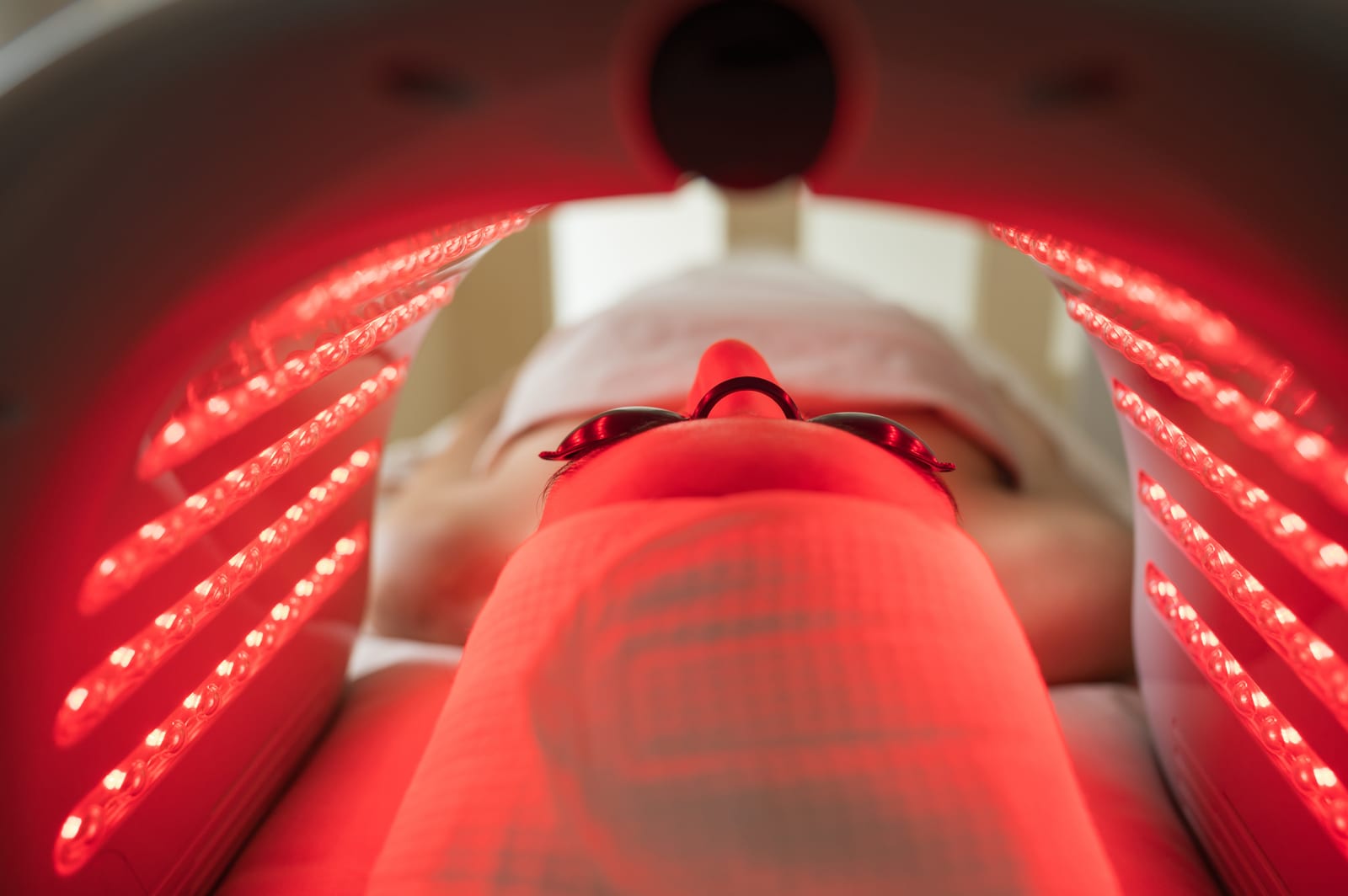
Red Light Therapy in Bellevue, WA
Photobiomodulation for skin, recovery, and cellular vitality.
- Surgeon-Led
Every protocol reviewed through a fellowship-trained facial plastic surgeon's anatomical lens.
- Full Modality Array
Radiofrequency, ultrasound, IPL, picosecond, pulsed-dye, and a complete injectable menu in-house.
- Hospitality-Led
Founded in 2022 around a comfort-first, homey clinic standard — quiet luxury without corporate distance.
- Bellevue Crossroads
15600 NE 8th St, Suite A-8 — minutes from Mercer Island, Kirkland, and Redmond.
What Photobiomodulation Actually Is
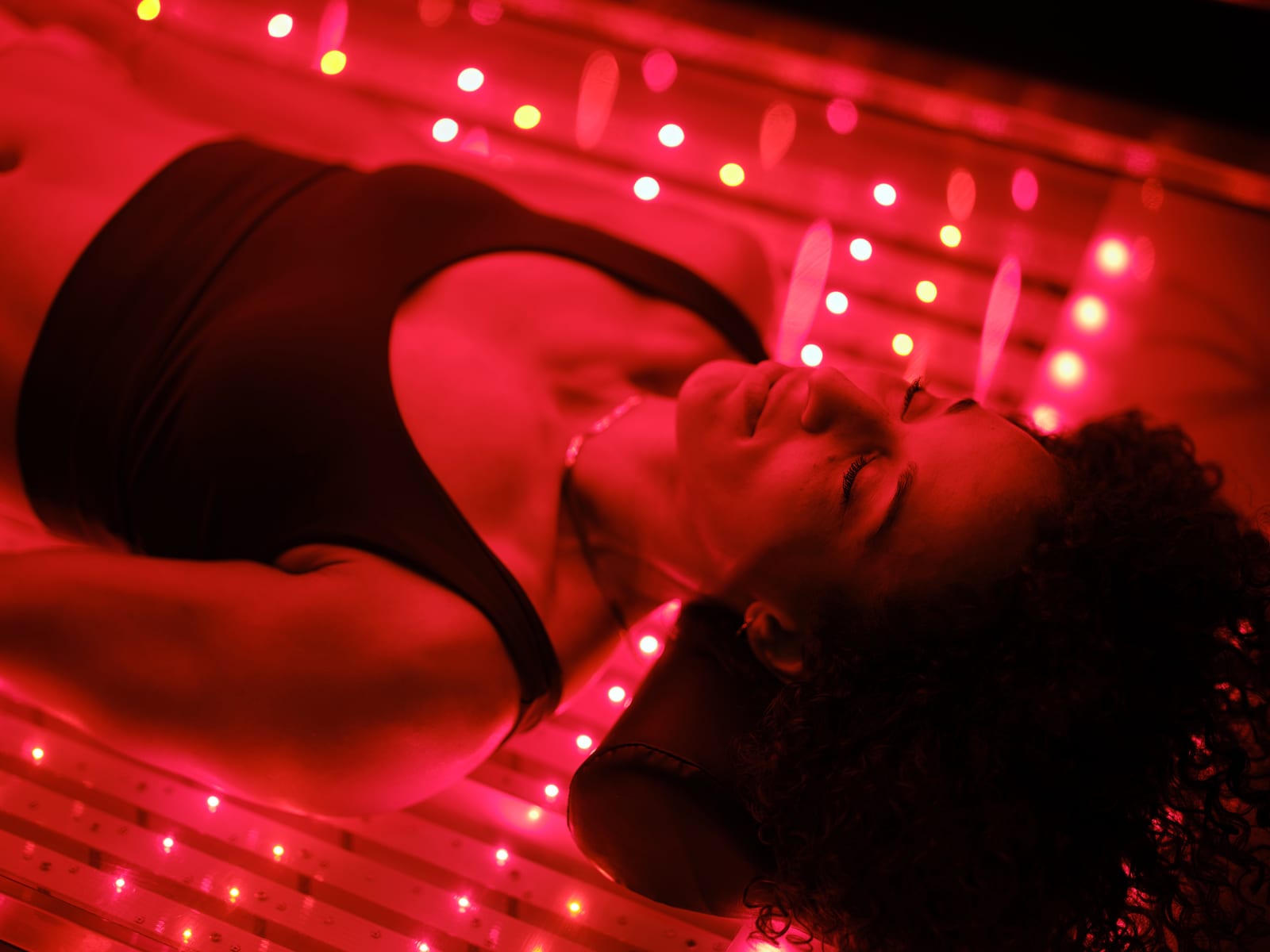
Photobiomodulation is not heat, not UV, and not a tanning device. The mechanism is photochemical, not thermal. Specific wavelengths in the red (roughly 630–680 nm) and near-infrared (roughly 800–880 nm) bands penetrate skin and superficial tissue and are absorbed by a mitochondrial enzyme called cytochrome c oxidase — part of the electron transport chain that generates the ATP your cells run on.
Red light therapy — clinically, photobiomodulation, or PBM — is a cellular-signaling intervention. Specific wavelengths of red and near-infrared light are absorbed at the level of the mitochondria, where they support the cellular machinery that drives recovery, skin renewal, and longer-term vitality. At Sun Aesthetic Clinic, photobiomodulation sits inside the Wellness branch as a physician-supervised, regenerative protocol — used on its own for skin quality and recovery, or layered into the broader longevity work the branch is built around.
What Photobiomodulation Actually Is
Photobiomodulation is not heat, not UV, and not a tanning device. The mechanism is photochemical, not thermal. Specific wavelengths in the red (roughly 630–680 nm) and near-infrared (roughly 800–880 nm) bands penetrate skin and superficial tissue and are absorbed by a mitochondrial enzyme called cytochrome c oxidase — part of the electron transport chain that generates the ATP your cells run on.
The downstream effect is a cellular-signaling cascade: ATP production is supported, reactive oxygen species are modulated in a regulated way, and nitric oxide is released from binding sites where it was inhibiting respiration — which is part of how local blood flow and oxygen delivery shift. The net clinical effect is regenerative and recovery-supporting at the cellular level — not a dramatic, single-session change, but a cumulative shift in how tissue repairs and signals itself over weeks of consistent exposure.
This is the framing that places red light therapy inside Dr. Jay Sun’s regenerative-medicine orbit rather than inside the spa or wellness-retail category it is sometimes slotted into.
What the Clinic Uses Photobiomodulation For
Red light therapy at Sun Aesthetic Clinic is offered for a defined set of indications where the evidence base is more mature and the cellular-signaling mechanism aligns with the goal:
- Skin quality and tone support. Red wavelengths support collagen and fibroblast activity in the dermis — used as a complement to in-clinic skin work or as a maintenance rhythm between aesthetic sessions.
- Recovery support. Post-workout, post-procedure, and general systemic recovery — the protocol supports the body’s own repair signaling rather than masking soreness or inflammation.
- Hair density support. Specific red-light wavelengths have a documented role in supporting hair follicle activity, often layered with the practice’s scalp-focused regenerative work for patients addressing early thinning.
- Cellular complement to other regenerative protocols. Photobiomodulation pairs naturally with peptide therapy, IV therapy, and the longitudinal vitality work Dr. Sun’s branch is anchored on.
The honest framing: outcomes are supporting and cumulative. Red light therapy is a regenerative input, not a single-event intervention. We are deliberate about not overstating what one session, or even one short series, will do.
Why “Just Light” Still Needs Physician Supervision
It is fair to ask why a light-based protocol needs medical oversight when consumer panels and red-light beds are widely available. Three clinical variables separate a clinical-grade protocol from a commodity exposure:
- Wavelength selection. Different indications respond to different bands. The red versus near-infrared distinction matters; so does the specific peak wavelength. Devices that emit a broad, unspecified red light are not interchangeable with devices designed around evidence-based bands.
- Dosimetry — irradiance times duration. The total dose delivered to tissue (typically expressed in joules per square centimeter) is what determines whether a session is sub-therapeutic, therapeutic, or past the point of diminishing returns.
- Pairing with other protocols. Where photobiomodulation is layered with peptide therapy, IV therapy, PRP for hair restoration, or microneedling for skin, sequencing and rhythm matter — and that is a physician-supervised decision.
Both a clinical-grade protocol and a wellness-retail red-light bed involve red light. Only one is reviewed against your goals, layered against your other protocols, and adjusted over time.
Why Dr. Jay Sun’s Regenerative-Medicine Framing Is the Right Home
Dr. Jay Sun, MD founded Sun Aesthetic Clinic and serves as the practice’s medical director. His background — anesthesiology and pain management, with a longstanding interest in regenerative medicine — anchors every protocol on the Wellness branch. Photobiomodulation is the cleanest example of what regenerative medicine means at the cellular level: an intervention whose mechanism is signaling rather than substitution, whose effect is cumulative rather than acute, and whose value is highest when layered into a longer-arc vitality plan.
That is why this protocol lives on the Wellness branch and not on the aesthetic-device side of the practice. It is a longevity input, reviewed and sequenced as one.
What to Expect in the Clinic
A session in the clinic’s photobiomodulation panel typically runs 15 to 30 minutes. There is no real downtime — patients describe a comfortable warmth rather than heat or discomfort — and you can return to your day immediately.
Rhythm matters more than any one session. For most indications, patients begin at two to three sessions per week and adjust the cadence over time as cumulative effects emerge. Skin quality and recovery support tend to read first; longitudinal benefits to cellular vitality unfold over weeks to months of consistent use. Dr. Sun’s team reviews and adjusts the protocol as your goals evolve.
How Red Light Pairs With Other Protocols
Inside the Wellness branch, photobiomodulation is rarely the only protocol in play — and that is the design intent.
- Peptide Therapy in Bellevue. Peptides and photobiomodulation are mechanistically complementary — both are signaling-level interventions, and many regenerative plans combine them deliberately.
- IV Therapy in Bellevue. IV protocols supply the cellular substrate — nutrients, hydration, antioxidant support — that photobiomodulation’s signaling cascade then puts to work.
- Scalp and hair restoration. For patients addressing early hair thinning, red light therapy is a natural complement to the practice’s PRP (platelet-rich plasma) scalp protocol, both delivered inside the Wellness branch.
- Cross-branch recovery support. For patients pursuing in-clinic skin work on the MedSpa side of the practice — microneedling and energy-based device protocols reviewed by Albert Yang, fellowship-trained facial plastic surgeon — photobiomodulation is often used as a recovery-supporting complement in the weeks that follow. The two branches share a clinic and a hospitality standard; this is the cleanest cross-branch pairing.
Photobiomodulation sits inside the broader Wellness & Longevity category — that is the right starting point if you are mapping multiple protocols.

The First Step Toward Natural-Looking Results
If photobiomodulation is on your radar — for skin quality, recovery, hair-density support, or as a regenerative complement to the wider Wellness work — the consultation is the right first step. Dr. Sun's team will map the protocol against your goals and your other work and design a rhythm that earns the cumulative effect this category is built on.
Frequently Asked
Is this just a "light bed"?
No. The clinic's photobiomodulation panel is selected for clinical-grade wavelength specificity and irradiance — and, more importantly, the protocol is wrapped in physician oversight, dosimetry, and sequencing against your other regenerative work. The commodity red-light-bed experience is the same category of input at a different standard of delivery.
Cellular signaling — what does the evidence actually say?
The evidence base for photobiomodulation is mature for some indications (certain wound healing, certain pain conditions, specific hair-restoration applications) and still developing for others. We frame outcomes honestly: red light therapy is a supporting and complementary protocol, not a stand-alone cure for any of the indications we use it for. The mitochondrial-signaling mechanism is well characterized; the clinical magnitude varies by indication and dose.
Is an at-home device equivalent to a clinic-grade protocol?
At-home devices have a role for maintenance between in-clinic sessions, and we are happy to advise on which devices are reasonable. The difference at the clinic is wavelength specificity, calibrated irradiance, and physician-supervised sequencing with the rest of your protocols. For many patients the right answer is both.
How often should I come in?
A typical starting rhythm is two to three sessions per week, adjusted as cumulative effects emerge. Maintenance rhythms are lower-frequency. The consultation maps the cadence against your goals and your other protocols.
Are there situations where photobiomodulation is not appropriate?
Pregnancy, certain photosensitizing medications, and active skin conditions in the treatment field are reviewed at the consultation. Eye protection is provided. The intake screens for the standard safety questions.
Is pricing published?
Pricing for photobiomodulation is shared in consultation rather than on the page — sessions are usually scaled into a broader Wellness plan, and we want the conversation to start with your goals rather than with a per-session number. Financing options are available through our financing page.
Complementary longevity protocols.
Medical Weight Loss
Physician-supervised weight management protocol with metabolic, nutritional, and pharmacological pillars.
Learn more WellnessGLP-1 Injections
GLP-1 receptor agonist therapy for medically supervised weight management.
Learn more WellnessIV Therapy
Vitamin, mineral, and amino acid infusions calibrated to wellness goals.
Learn more WellnessPeptide Therapy
Targeted peptide protocols for recovery, longevity, and metabolic health.
Learn morePricing is shared in consultation.
Our pricing is a function of the protocol your anatomy actually needs — not a menu line item. We share specifics during your complimentary consultation, where every cost is contextualized inside the plan it belongs to. Financing options are available for protocols of greater scope.
