

Vascular, Veins & Tattoo Removal
Facial telangiectasia, leg veins, and unwanted tattoo pigment cleared through Vbeam Pro, Nordlys IPL, and PicoWay laser sequencing.
- Surgeon-Led
Every protocol reviewed through a fellowship-trained facial plastic surgeon's anatomical lens.
- Full Modality Array
Radiofrequency, ultrasound, IPL, picosecond, pulsed-dye, and a complete injectable menu in-house.
- Hospitality-Led
Founded in 2022 around a comfort-first, homey clinic standard — quiet luxury without corporate distance.
- Bellevue Crossroads
15600 NE 8th St, Suite A-8 — minutes from Mercer Island, Kirkland, and Redmond.
Surgeon-Led Standard on Every Laser Plan
Every laser protocol at Sun Aesthetic Clinic is reviewed by Albert Yang, MD — our fellowship-trained facial plastic surgeon — and Dr. Jay Sun, MD, founder and medical director. Dr. Yang trained through AAFPRS-recognized fellowships at Emory and Premier Image, with prior head-and-neck reconstructive surgery training.
Sun Aesthetic Clinic is a surgeon-led medical spa in Bellevue’s Crossroads district, and this is the concern page for three related-but-distinct conversations that route through our laser-light platforms — vascular concerns (rosacea-driven redness, broken capillaries, telangiectasias), facial and body veins, and tattoo removal. All three share a clinical principle: a calibrated wavelength of light is delivered to a specific chromophore — hemoglobin inside a vessel, ink particles inside the dermis — without collateral injury to surrounding skin. The wavelength, pulse duration, fluence, and surface cooling are not the same across indications, which is why the consultation begins with a clinical read before any platform is named.
Surgeon-Led Standard on Every Laser Plan
Every laser protocol at Sun Aesthetic Clinic is reviewed by Albert Yang, MD — our fellowship-trained facial plastic surgeon — and Dr. Jay Sun, MD, founder and medical director. Dr. Yang trained through AAFPRS-recognized fellowships at Emory and Premier Image, with prior head-and-neck reconstructive surgery training. His role is to set the parameter standard — wavelength, pulse, fluence, cooling — for every energy-based protocol on the menu. Anatomical precision on vascular and tattoo work is the read of the vessel or the ink under the skin, and the parameter map built against that read.
Three Concerns, One Clinical Family
Vascular work and tattoo removal share a mechanism — laser light delivered to a chromophore — but the targets differ.
Vascular concerns — rosacea redness, broken capillaries, telangiectasias. The visible problem is hemoglobin inside dilated vessels at the surface of the skin. Rosacea reads as diffuse facial flushing and fine vessels across the cheeks and nose. Telangiectasias are the persistent red threads that develop with sun damage, aging, hormonal shifts, and genetic predisposition. Broken capillaries on the cheeks, nostrils, and “V” of the chest are the same category at a slightly different caliber. The chromophore is oxyhemoglobin — a wavelength preferentially absorbed by it coagulates the vessel without injuring surrounding skin.
Facial and body veins. Larger and deeper than telangiectasias — facial spider veins around the nose and cheeks, leg spider veins, and reticular veins. Same chromophore, but depth and caliber shift the parameter map: deeper vessels need longer pulse duration and higher fluence. Skin type also shifts the protocol — on lighter skin types (Fitzpatrick I–III) a 595 nm pulsed-dye platform clears most superficial vessels efficiently; on darker skin types (Fitzpatrick IV–VI), wavelength selection shifts away from settings that would risk absorption at epidermal melanin.
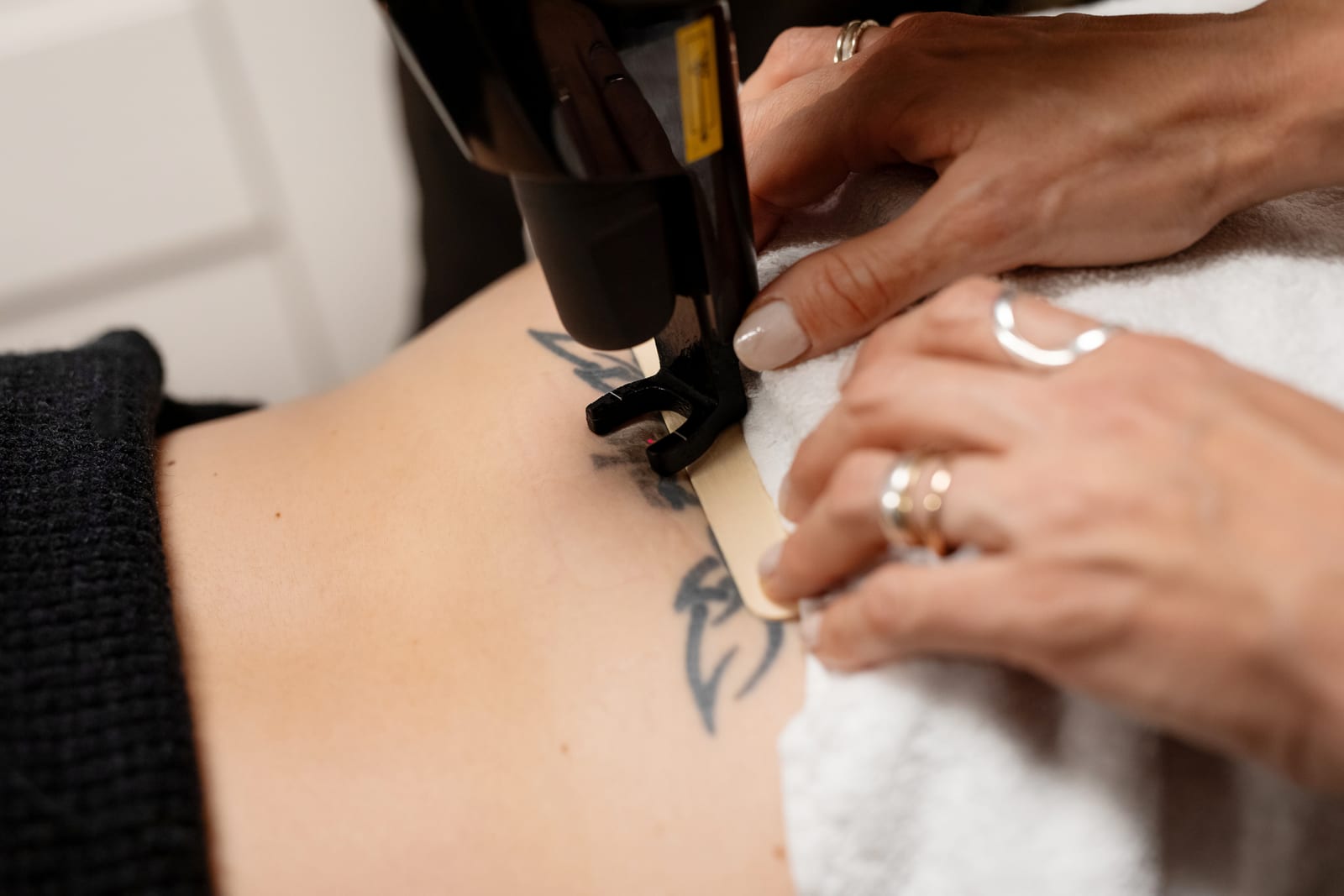
Tattoo removal. Different mechanism, same laser-light family. The chromophore is tattoo ink, and the dominant interaction is photoacoustic — picosecond pulses shatter the ink particle into fragments the body clears through the lymphatic system. Color matters: red, orange, yellow inks absorb green light (532 nm); blue and green inks absorb near-infrared (785 nm); black and dark inks absorb deeper near-infrared (1064 nm). A multi-color tattoo is a layered protocol, each wavelength addressed to its target ink across the series.
Treatment Options at Sun Aesthetic Clinic
Protocol selection is concern-driven. Below is how the conversations map.
Vascular Concerns and Rosacea Redness — Vbeam Pro
Vbeam Pro Laser in Bellevue (vascular) is the gold-standard 595 nm pulsed-dye laser, and it is the platform we reach for first on rosacea redness, diffuse facial flushing, and the vessel pattern of rosacea presentations. Integrated dynamic cooling protects the epidermis pulse-by-pulse, and the protocol can run in either a non-purpuric (no-downtime) or a purpuric (faster-clearance, transient bruising) configuration. Rosacea is a chronic condition; Vbeam manages the visible vascular layer rather than curing it — we map a long-term plan that pairs an initial series with maintenance, daily medical-grade skincare, and trigger management.
Broken Capillaries and Telangiectasias — Vbeam Pro + Nordlys IPL
For discrete broken capillaries and individual telangiectasias, the Vbeam Pro Laser in Bellevue (vascular) protocol is the most efficient route — vessel-by-vessel clearance. For diffuse cases — broad networks of fine vessels combined with sun-damage pigment and tone-and-texture concerns on lighter skin types — the conversation often routes to Nordlys IPL in Bellevue instead, because intense pulsed light addresses the mixed presentation in a single session.
Tattoo Removal — PicoWay Picosecond Laser
PicoWay Tattoo Removal in Bellevue is the picosecond-laser platform we use for tattoo removal across the full ink-color range. Three wavelengths — 532 nm for warm-spectrum inks (red, orange, yellow), 785 nm for cool-spectrum inks (blue, green), and 1064 nm for black and dark inks — give the provider three absorption profiles to select against the target. The picosecond pulse shifts the dominant mechanism from photothermal to photoacoustic, improving the safety profile across skin types compared to older nanosecond Q-switched platforms. PicoWay is also first-line for Fitzpatrick IV–VI skin where IPL would carry unacceptable post-inflammatory hyperpigmentation risk.
Wavelength and Skin Type
On lighter skin types (Fitzpatrick I–III) the safe window is widest. As skin type darkens it narrows — epidermal melanin absorbs more shorter-wavelength light, which is why broad-spectrum IPL is generally contraindicated on Fitzpatrick IV–VI. PicoWay’s 1064 nm and Vbeam Pro’s 595 nm (with integrated cooling) are the workhorses on darker skin types. Skin-type read happens before the platform is named.
What to Expect Across the Series
Meaningful clearance is a multi-session conversation, and session counts vary by concern.
Vascular work. Some patients see same-day clearance on small targeted vessels — a single cherry angioma, an isolated telangiectasia. More typically, clearance settles over 1 to 3 weeks as the body resorbs the coagulated vessels, compounding across a series. A typical Vbeam course runs 3 to 5 sessions, spaced 4 to 6 weeks apart. Diffuse rosacea and port-wine stains can require longer courses. The bruising disclosure: pulsed-dye lasers run in either a non-purpuric protocol (no bruising, gradual clearance) or a purpuric protocol (transient bruising over 7 to 14 days, faster clearance per session). The decision is made with the patient at consultation against downtime tolerance, indication, and clearance trajectory.
Tattoo removal. Multi-session by clinical necessity, and session counts vary enormously. A small amateur tattoo in a well-perfused area can clear in 4 to 6 sessions. A dense, professional, multi-color tattoo on the lower leg can run 8 to 12 sessions or more. Ink type, density, depth, tattoo age, body-area perfusion, and skin type all factor in. Sessions are spaced 6 to 8 weeks apart to let the lymphatic system clear fragmented pigment between treatments. We give honest ranges at consultation after looking at the tattoo directly. We will not pre-promise a session count we cannot stand behind.
Across both surfaces, downtime is generally manageable — mild erythema, transient warmth, and a pinpoint reaction at the treated site typically resolve within hours to a day. Aftercare and SPF discipline are mapped at consultation against the protocol you are running.
Why Parameter Selection Is Technique-Driven
The shorthand the broader market sells on lasers is the platform name — Vbeam, IPL, PicoWay. The honest answer is that the platform is the tool, not the protocol. Two patients with what looks like the same rosacea presentation can carry different vessel depth, caliber, skin type, and downtime tolerance — and the right protocol for each is a different parameter map on the same platform. Two tattoos that look superficially similar can carry different ink, density, age, and depth, and the right wavelength sequence is not the same.
The surgeon-led standard sits above the platform menu. Wavelength is selected against the chromophore. Pulse duration and fluence are selected against the depth and caliber of the target. Surface cooling is calibrated to the skin type and the area being treated. That is what the fellowship-trained facial plastic surgeon review brings to every laser plan on the menu.
Meet your fellowship-trained provider
Related Concerns
Sun damage, melasma & rosacea — the adjacent concern page covering sun-damage pigmentation, melasma management, and the rosacea conversation where the dominant concern is pigment-plus-redness rather than vascular work alone. Many patients route between the two concern pages, particularly where the face carries both a vascular layer and a pigment layer that benefit from sequenced protocols.

The First Step Toward Natural-Looking Results
Every vascular and tattoo-removal plan at Sun Aesthetic Clinic begins with an unhurried conversation, a clinical read of the target — vessel or ink — and a parameter map calibrated to the indication and skin type in front of us. No preset protocols. Just refined, surgeon-reviewed laser work in a boutique practice in Bellevue Crossroads.
Frequently Asked
Vbeam vs PicoWay vs IPL — when is each one right?
Vbeam Pro is the targeted vascular protocol — 595 nm pulsed-dye, hemoglobin chromophore — for rosacea redness, broken capillaries, telangiectasias, and vascular lesions specifically. PicoWay is the pigment and tattoo protocol — picosecond pulses across 532, 785, and 1064 nm — for tattoo removal across the full ink-color range, stubborn pigment, and the first-line laser on Fitzpatrick IV–VI skin where IPL would be contraindicated. Nordlys IPL is broad-spectrum — better for mixed photo-aging on lighter skin types where pigment, vascular, and tone-and-texture concerns combine.
Will Vbeam Pro bruise me?
It depends on which protocol we run. A non-purpuric protocol uses gentler fluences across a longer series — no bruising, gradual clearance — for patients who cannot accept visible downtime. A purpuric protocol uses higher fluences and produces a transient bruise-like discoloration that resolves over 7 to 14 days, with faster clearance per session. The decision is made with the patient at consultation against downtime tolerance, indication, and clearance trajectory. The clinic will not run a purpuric protocol on a patient who has asked for no downtime.
Tattoo removal — how many sessions will it really take?
It varies enormously, and we will not pre-commit to a count we cannot stand behind. A small amateur tattoo in a well-perfused area can clear in 4 to 6 sessions. A dense, professional, multi-color tattoo on the lower leg can run 8 to 12 sessions or more. Ink type, density, depth, tattoo age, body-area perfusion, and skin type all factor in. Sessions are spaced 6 to 8 weeks apart. We give honest ranges at consultation after looking at the tattoo directly.
Are these lasers safe for darker skin types?
With careful platform and parameter selection, yes — platform choice on Fitzpatrick IV–VI is a clinical safety decision, not a cosmetic preference. PicoWay's 1064 nm is the first-line option on darker skin types for tattoo and pigment work because it bypasses superficial epidermal melanin. Vbeam Pro at 595 nm with integrated cooling can be run safely on darker skin when the parameter map is calibrated specifically. Nordlys IPL is generally contraindicated on Fitzpatrick IV–VI.
Can I have these protocols during pregnancy?
We defer Vbeam Pro and PicoWay during pregnancy out of an abundance of caution. The conversation can resume postpartum and, where applicable, outside the breastfeeding window.
Is pricing on the site?
Pricing is shared in the complimentary consultation rather than published on the page. Vascular and tattoo plans are indication-, area-, and session-count-driven — a quoted number on a site cannot honestly reflect the protocol the patient actually needs. A written estimate is provided at consultation, and there is no obligation to proceed the same day.
Treatments commonly sequenced for this concern.
Vbeam Pro Laser
Pulsed-dye laser for facial telangiectasia, rosacea, port-wine stains, and vascular concerns.
Learn more Advanced Skin RejuvenationNordlys IPL
Intense pulsed light for pigment, vascularity, and rosacea — calibrated to skin type.
Learn more Advanced Skin RejuvenationPicoWay Laser
Picosecond laser for pigment, melasma, and tattoo removal — gentler on melanated skin than older Q-switched devices.
Learn more