

XERF in Bellevue, WA
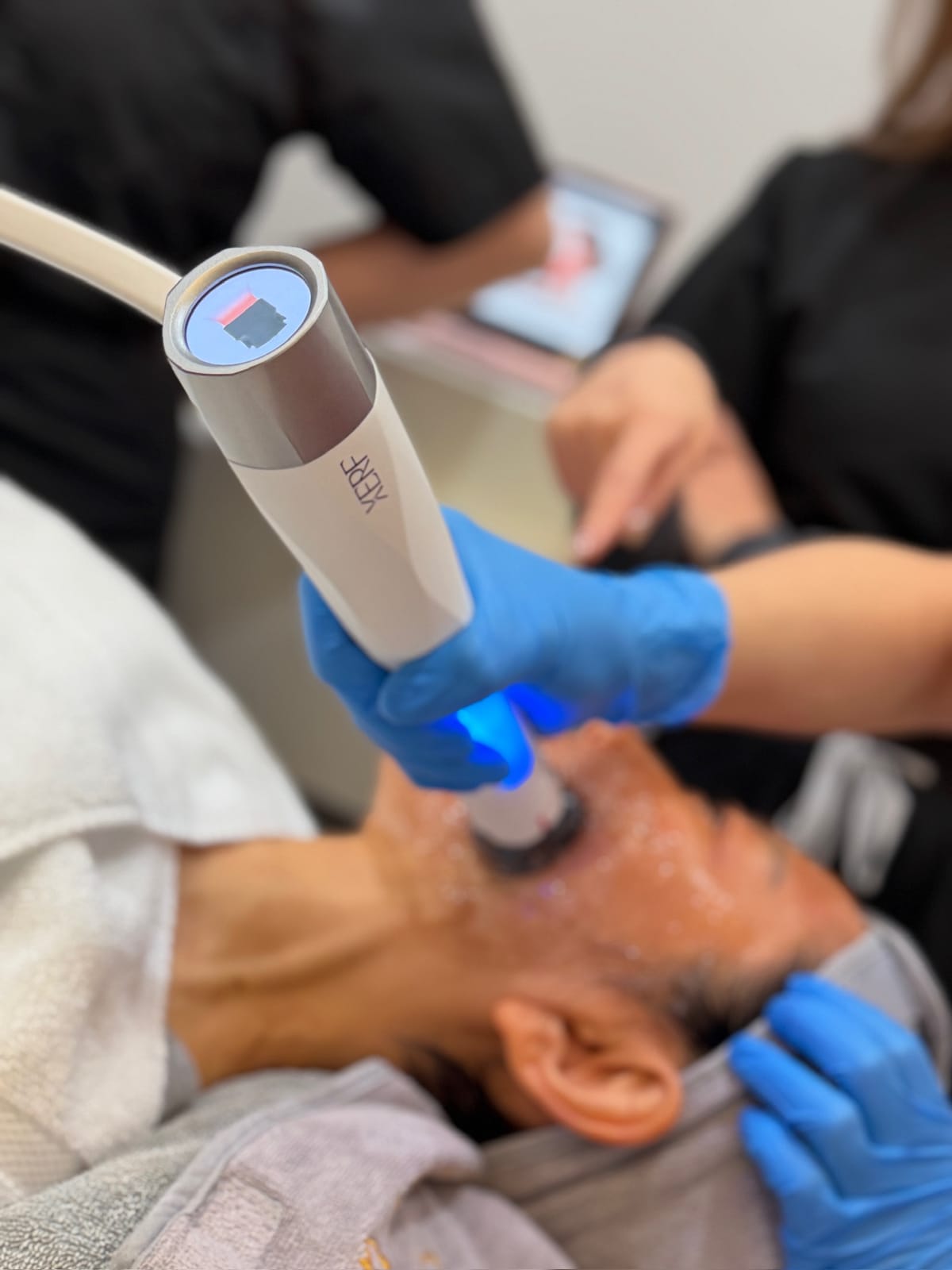
Bipolar radiofrequency device for surface skin tightening and texture refinement.
- Surgeon-Led
Every protocol reviewed through a fellowship-trained facial plastic surgeon's anatomical lens.
- Full Modality Array
Radiofrequency, ultrasound, IPL, picosecond, pulsed-dye, and a complete injectable menu in-house.
- Hospitality-Led
Founded in 2022 around a comfort-first, homey clinic standard — quiet luxury without corporate distance.
- Bellevue Crossroads
15600 NE 8th St, Suite A-8 — minutes from Mercer Island, Kirkland, and Redmond.
What XERF Is
XERF is a radiofrequency-based skin-tightening device. RF energy is delivered into the dermal and subdermal layers to drive a thermal stimulus, immediate collagen contraction, and a slower neocollagenesis response across the months that follow. It sits inside the same energy-tightening family as Thermage, Agnes RF, and Scarlet RF — different RF approaches at different depths.
Sun Aesthetic Clinic is a surgeon-led medical spa in Bellevue’s Crossroads district, and XERF is the radiofrequency tightening protocol we reach for on face, jawline, and neck laxity that calls for energy-based remodeling — without the SMAS-depth lift of Ultherapy or the broad-area commitment of Thermage. What differentiates the protocol here is the layer above the device: surgeon-led anatomical mapping that selects the treatment grid, the depth, and the parameter set against the face in front of us before the first pulse is delivered.
What XERF Is
XERF is a radiofrequency-based skin-tightening device. RF energy is delivered into the dermal and subdermal layers to drive a thermal stimulus, immediate collagen contraction, and a slower neocollagenesis response across the months that follow. It sits inside the same energy-tightening family as Thermage, Agnes RF, and Scarlet RF — different RF approaches at different depths.
XERF is an emerging platform in the broader U.S. medspa landscape, and we frame it honestly rather than overselling it. The device is one input. The surgical-grade anatomical judgment that selects how and where the energy is delivered is the differentiator. This is the standard we hold across the Advanced Skin Rejuvenation category.
Treatment Areas and Indications
The XERF protocol at Sun Aesthetic is mapped to the zones where diffuse-to-moderate laxity has begun to show but a structural lift is not the right next step.
- Forehead and upper-face — early-laxity skin tightening across the forehead window.
- Cheek and mid-face — diffuse mid-face laxity where dermal remodeling, rather than volume restoration, is the right tool.
- Jawline definition — softening of early jowl onset and the jawline-to-neck transition.
- Neck — mild cervical skin laxity inside the energy-tightening window. Heavier neck descent is referred into the Ultherapy or surgical conversation.
The primary concerns these areas address are Facial aging and sagging and Eyes, jawline, and double chin.
Why Surgeon-Led Anatomical Mapping Matters Here
Radiofrequency tightening is, at its core, a depth-and-grid decision. The energy has to be delivered into the layer that will respond to it, in a pattern that respects the underlying anatomy, at parameter settings that fire the collagen response without overshooting comfort or safety. Those decisions are anatomy-driven, not protocol-card driven — they are exactly the kind of anatomical precision the wider Sun Aesthetic system runs on.
The XERF plan is reviewed by Albert Yang, MD — our fellowship-trained facial plastic surgeon, AAFPRS-recognized through fellowships at Emory and Premier Image. His role on the medspa branch is to anchor the anatomical and parameter standard for every energy-device protocol the clinic runs. On XERF, that review layer governs three decisions:
- Treatment-grid mapping — how the face and neck are divided into zones, where the protocol concentrates additional passes, and where it deliberately pulls back to protect surrounding anatomy.
- Depth and parameter selection — calibrating energy delivery against skin thickness, baseline laxity, fascia depth, and the tolerable thermal endpoint for each zone.
- Sequencing inside the wider plan — deciding whether XERF is the right tool on its own, the right adjunct to a Thermage or Ultherapy plan, or whether a different modality is the better anatomical match.
That review layer is the reason the XERF protocol here is not a commodity RF session.
Meet your fellowship-trained provider
What to Expect
XERF is a non-invasive, in-clinic protocol. Session structure follows general radiofrequency-tightening norms; the specifics are confirmed at consultation.
- Session length — inside the standard RF-tightening window; confirmed per treatment plan.
- In-session sensation — a warming pulse across the treatment grid, with comfort measures available where appropriate.
- Downtime — minimal for non-invasive RF protocols; transient redness or warmth is common and usually resolves the same day.
- Sessions — a treatment series is typical. The number of sessions and the spacing between them are set against your baseline at consultation.
- Result emergence — modest tightening over the first weeks, with the meaningful build across the months that follow as collagen remodels in.
XERF Versus Its Siblings — How We Pick the Right Tool
XERF sits inside a small family of energy-tightening protocols at the clinic, and the right tool depends on depth, area, and the result you are after.
- Thermage (RF tightening) — monopolar radiofrequency built as a single-session anchor across broad treatment areas (full face, periorbital, body). For broad-area single-session work, Thermage is typically the right call.
- Ultherapy (ultrasound tightening) — micro-focused ultrasound that reaches the SMAS, the structural layer addressed during a facelift. Ultherapy lifts. XERF tightens. Structural descent is an Ultherapy conversation; surface and dermal laxity is the XERF conversation.
- Agnes RF (focal RF microneedling) — precision-depth RF microneedling for targeted small-area concerns (under-eye bags, defined jowl pockets, focal submental fat). Agnes goes deep at a precise point; XERF works across a treatment-grid surface.
- Scarlet RF (RF microneedling) — RF microneedling for skin quality and texture refinement. Scarlet is a texture tool; XERF is a tightening tool. Adjacent but distinct concerns.
The call is not which device is strongest in the abstract — it is which device matches the anatomical problem the consultation has identified.
Frequently Paired With
XERF is rarely the whole plan. It sits inside a broader anatomical conversation about tightening, motion, volume, and skin quality.
- Botox in Bellevue — XERF tightens the dermal envelope; Botox softens the dynamic lines drawn into it.
- Dermal Fillers in Bellevue — XERF addresses surface laxity; fillers restore the volume that has been lost underneath it.
- Hydrafacial in Bellevue — the baseline skin-quality protocol that runs underneath every advanced plan at the clinic.

The First Step Toward Natural-Looking Results
Every XERF plan begins with an unhurried conversation, an anatomical read of where your laxity actually sits, and a treatment-grid map scaled to the result you have asked for. Surgeon-led radiofrequency tightening in a boutique practice in Bellevue Crossroads.
Frequently Asked
XERF versus Thermage — which one do I need?
They are siblings inside the RF tightening family, not the same device. Thermage is built around a single-session monopolar anchor across broad areas and carries an FDA-cleared eye tip for periorbital work. XERF carries a different surface footprint and is typically run as a treatment series. The anatomical call at consultation is which device matches the area, the laxity, and the result you are after.
Is XERF painful?
Most patients describe a warming sensation across the treatment grid rather than discrete pain. The comfort-first visit standard — anchored in Dr. Jay Sun's anesthesiology background — extends to every XERF session, and topical comfort measures are available where they make sense.
How many sessions does XERF take?
A treatment series is the norm. The specific number of sessions and the spacing between them is set at consultation against your baseline.
Is there downtime?
Minimal for non-invasive RF tightening. Transient redness or warmth is common and usually resolves the same day; most patients return to their normal day directly from the appointment.
Is pricing on the site?
Pricing is shared in the complimentary consultation rather than published on the page. XERF is series-scaled and area-scaled — a written estimate is provided at consultation, with no obligation to proceed the same day.
Related treatments in your category.
Ultherapy
Micro-focused ultrasound for foundational SMAS-layer lifting — non-surgical brow, jawline, and neck refinement.
Learn more Advanced Skin RejuvenationThermage
Monopolar radiofrequency for non-surgical skin tightening across the face and body.
Learn more Advanced Skin RejuvenationAgnes RF
Microinsulated radiofrequency for targeted submental fat, eye-area laxity, and acne lesions.
Learn more Advanced Skin RejuvenationScarlet RF
Microneedling-delivered radiofrequency for tightening, scar refinement, and texture.
Learn more Advanced Skin RejuvenationONDA PRO
Targeted Coolwaves® microwave energy for full body contouring, submental fat reduction, and skin tightening.
Learn more Advanced Skin RejuvenationLaser Hair Removal
Long-term hair reduction via diode and Nd:YAG laser, sequenced over a treatment series.
Learn morePricing is shared in consultation.
Our pricing is a function of the protocol your anatomy actually needs — not a menu line item. We share specifics during your complimentary consultation, where every cost is contextualized inside the plan it belongs to. Financing options are available for protocols of greater scope.
