

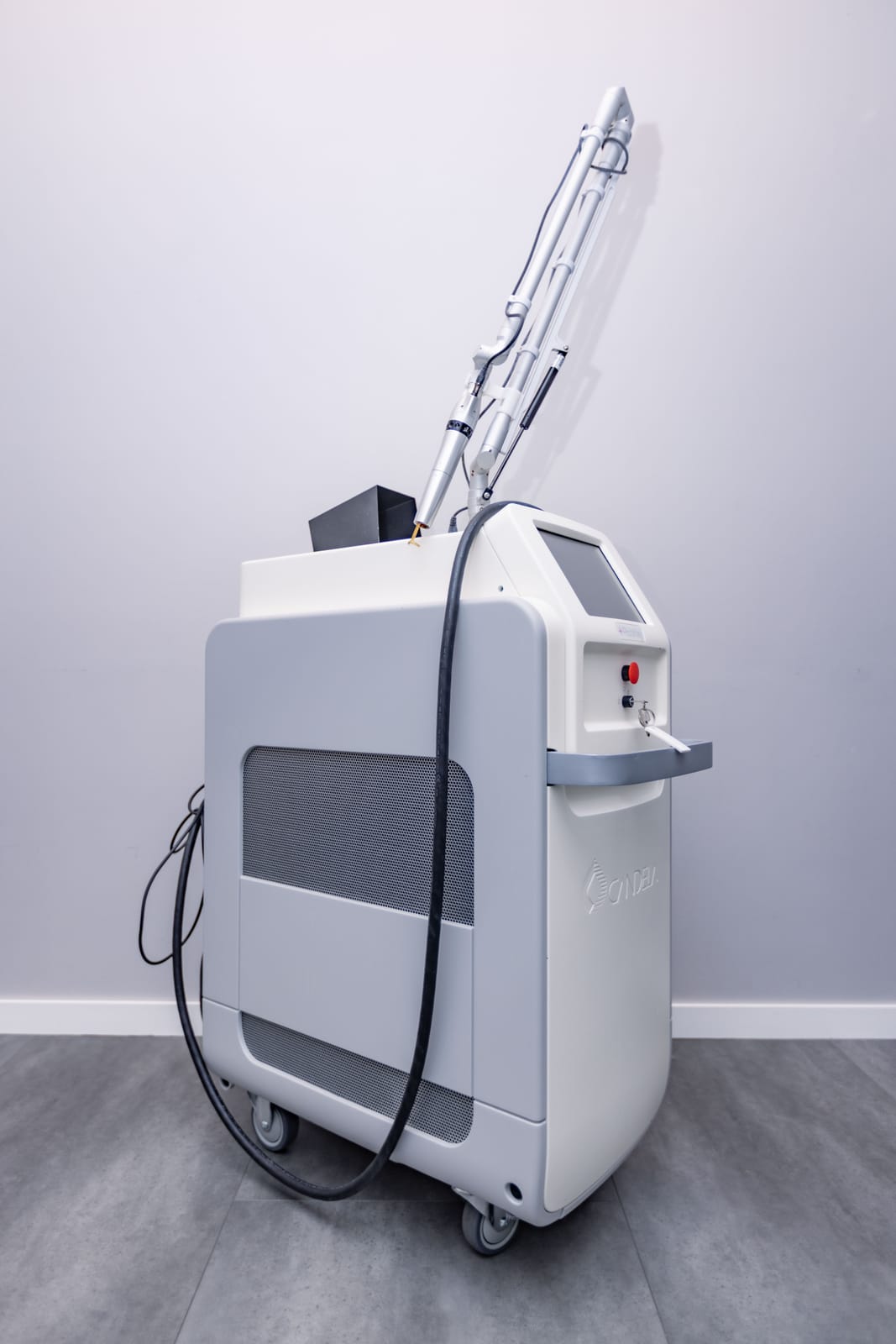
PicoWay Laser in Bellevue, WA
Picosecond laser for pigment, melasma, and tattoo removal — gentler on melanated skin than older Q-switched devices.
- Surgeon-Led
Every protocol reviewed through a fellowship-trained facial plastic surgeon's anatomical lens.
- Full Modality Array
Radiofrequency, ultrasound, IPL, picosecond, pulsed-dye, and a complete injectable menu in-house.
- Hospitality-Led
Founded in 2022 around a comfort-first, homey clinic standard — quiet luxury without corporate distance.
- Bellevue Crossroads
15600 NE 8th St, Suite A-8 — minutes from Mercer Island, Kirkland, and Redmond.
What PicoWay Is — Picosecond Pulses Through Three Wavelengths
PicoWay is a picosecond laser, meaning the laser pulses are delivered in trillionths of a second — orders of magnitude shorter than the nanosecond pulses used by older Q-switched tattoo-removal platforms. That timescale change matters because of how the pulses interact with pigment and tissue.
Sun Aesthetic Clinic is a surgeon-led medical spa in Bellevue’s Crossroads district, and PicoWay is our picosecond-laser platform — a Candela system that runs four wavelengths (532 nm, 730 nm, 785 nm, 1064 nm) and addresses three clinically distinct concerns: tattoo removal across the full ink-color range, stubborn pigment that has resisted IPL or topical work (melasma, sun spots, post-inflammatory hyperpigmentation), and skin revitalization through the PicoWay Resolve handpiece. PicoWay is also the first-line laser at the clinic for Fitzpatrick IV–VI skin types where IPL carries possible post-inflammatory hyperpigmentation risk. If you have been turned away from an IPL-only clinic, this is the protocol that was likely indicated.
What PicoWay Is — Picosecond Pulses Through Three Wavelengths
PicoWay is a picosecond laser, meaning the laser pulses are delivered in trillionths of a second — orders of magnitude shorter than the nanosecond pulses used by older Q-switched tattoo-removal platforms. That timescale change matters because of how the pulses interact with pigment and tissue.
A nanosecond-pulse laser breaks pigment primarily through photothermal action — the pulse heats the pigment particle, the heat radiates outward, and the surrounding skin absorbs a fraction of that thermal load. The result is effective ink and pigment clearance, but with a wider safety margin requirement on skin types where epidermal melanin will also absorb the thermal spillover.
A picosecond pulse, by contrast, is short enough that the dominant mechanism shifts to photoacoustic — the pulse vibrates the pigment particle so quickly that the particle shatters into smaller fragments under mechanical (rather than thermal) stress. The fragments are then cleared by the body’s lymphatic system over the weeks following the session. The collateral heat in the surrounding tissue is meaningfully lower, which is the entire reason picosecond platforms have replaced nanosecond platforms as the clinical standard for tattoo and pigment work, and the reason the safety profile across skin types improves on a picosecond platform.
PicoWay’s four wavelengths give the provider four different absorption profiles to select against the target:
- 532 nm — green visible light. Strongly absorbed by red, orange, and yellow tattoo inks and by superficial epidermal pigment (sun spots, lentigines, freckles in lighter skin types).
- 730 nm — titanium-sapphire red. A dedicated pigment wavelength with strong melanin absorption at a gentler depth profile — well-suited to benign pigmented lesions and stubborn sun-spot work, and an additional tool against blue and green tattoo inks.
- 785 nm — near-infrared. Strongly absorbed by blue and green tattoo inks. Also the wavelength used in the PicoWay Resolve handpiece for dermal-remodeling skin revitalization work.
- 1064 nm — deeper near-infrared. The workhorse wavelength for black, dark blue, and dark brown tattoo ink, for deeper dermal pigment, and — critically — the wavelength with the safest profile on Fitzpatrick IV–VI skin because it bypasses superficial epidermal melanin and targets deeper chromophores.
The wavelength-selection layer is what makes PicoWay a single-platform answer to three distinct clinical concerns. The protocol-review layer is what makes that selection right for the patient in front of us.
Three Application Categories
PicoWay sits at the intersection of three different conversations at the clinic, and the protocol differs substantially across them.
Tattoo Removal Across the Full Ink-Color Range
This is the highest-volume PicoWay indication, and the one the platform was originally engineered for. The 1064 nm wavelength handles black and dark inks; 532 nm handles the warm-spectrum inks (red, orange, yellow); 785 nm handles the cool-spectrum inks (blue, green) that older single-wavelength platforms historically struggled with. A multi-color tattoo is treated as a layered protocol — each wavelength addressed to its target ink, across the series of sessions.
Tattoo removal is multi-session by clinical necessity. The picosecond pulse shatters pigment; the body then clears the fragments over the following 6–8 weeks; the next session addresses the residual ink that becomes visible once the upper layer is cleared. We will be direct about session counts at consultation — they vary enormously based on ink type, ink density, ink depth, tattoo age, location on the body, and skin type. A small amateur tattoo in a well-perfused area can clear in 4–6 sessions. A dense, professional, multi-color tattoo on the lower leg can run 8–12 sessions or more. We will give you an honest range at consultation, and we will not pre-promise a specific count.
Stubborn Pigment — Melasma, Sun Spots, Post-Inflammatory Hyperpigmentation
The second PicoWay indication is the pigment work that has resisted other approaches. The most common consultation in this category: a patient who has run IPL on sun-damage pigmentation with diminishing returns, or who has melasma that flares back after every topical regimen, or who has post-inflammatory hyperpigmentation following acne, an earlier laser treatment, or a procedure scar.
PicoWay addresses these through a combination of 532 nm work on superficial pigment and 1064 nm work on deeper or more melanin-sensitive presentations. The protocol is gentler than the tattoo-removal protocol — lower fluences, more passes — and is calibrated against the specific pigment concern.
A direct word on melasma: melasma is a chronic, recurrent condition. No laser, no topical, and no in-clinic protocol cures it. PicoWay is one of the safer and more effective in-clinic options for managing melasma — particularly on darker skin types where IPL is contraindicated — but the honest framing is management, not cure. A successful melasma protocol delivers meaningful clearance during the active series, and is then paired with a daily SPF + topical regimen and an annual maintenance cadence that we map at consultation. We will not promise a one-and-done outcome on melasma, and any clinic that does is selling the wrong story.
Sun spots and post-inflammatory hyperpigmentation respond more durably and typically run 3–6 sessions to clearance, with results consolidating across the series.
PicoWay Resolve — Skin Revitalization
The third PicoWay indication is the Resolve handpiece — a fractional picosecond protocol that delivers the 785 nm or 1064 nm wavelength in a grid pattern through the dermis. The photoacoustic effect, applied through the dermis rather than against pigment, triggers a controlled dermal-remodeling response: new collagen and elastin deposition, refined texture, more even tone, and softening of fine lines over the months following the series.
PicoWay Resolve is the option for patients who want the texture-and-tone benefit of a fractional laser without the thermal injury and extended downtime of an ablative or non-ablative fractional resurfacing protocol. Most patients run a 4-session series spaced 3–4 weeks apart, with results compounding through the series and continuing to refine for 3–4 months after the final session as the dermal remodeling completes.
Why PicoWay Is the First-Line Protocol for Fitzpatrick IV–VI Skin
This is the section of the page that matters most, and where we will be direct about a clinical reality the broader aesthetic market routinely sidesteps.
Many of the most common in-clinic pigment and skin-quality protocols — IPL, Q-switched nanosecond lasers, fractional non-ablative protocols — carry meaningfully elevated post-inflammatory hyperpigmentation (PIH) risk on Fitzpatrick IV, V, and VI skin. The reason is the same in every case: the protocol’s mechanism relies on thermal energy absorbed at or near the level of epidermal melanin, and on darker skin types the epidermal melanin absorbs an unsafe fraction of that energy. The wrong protocol on Fitz IV–VI skin does not produce a sub-optimal cosmetic result. It produces PIH that can take months to resolve and that, in some cases, becomes a new pigment problem layered on top of the original one.
PicoWay sits on a different mechanism. The picosecond pulse duration shifts the dominant interaction from photothermal to photoacoustic. The 1064 nm wavelength bypasses superficial epidermal melanin. The combination — picosecond + photoacoustic + 1064 nm — is the lowest-risk in-clinic profile for pigment and tattoo work on darker skin types currently available on the platform market.
The clinic uses PicoWay as the first-line laser in every scenario where IPL would be contraindicated by skin type. If you are Fitzpatrick IV–VI and have been told by an IPL-only clinic that they “can’t treat your skin,” or if you have been treated and developed PIH afterward, the consultation conversation here starts with a skin-type read and a wavelength + pulse-parameter map that fits your skin — not an apology for the platform mismatch.
This is a clinical priority, not a marketing position.
What to Expect — Per Indication
Each PicoWay indication runs a different protocol cadence, and the honest framing at the front end matters.
- Tattoo removal — multi-session series spaced 6–8 weeks apart. Session counts vary enormously based on ink type, density, depth, tattoo age, and body area. Honest ranges given at consultation; no pre-committed count.
- Stubborn pigment (melasma, sun spots, PIH) — typically 3–6 sessions, spaced 4–6 weeks apart. Melasma is managed across an ongoing maintenance cadence; sun spots and PIH respond more durably.
- PicoWay Resolve skin revitalization — typically a 4-session series, spaced 3–4 weeks apart, with dermal-remodeling results continuing to refine for 3–4 months after the final session.
Across all three indications, downtime is minimal — most patients see mild erythema and a transient frosting or pinpoint reaction at the treated site that resolves within hours to a day. Specific aftercare and SPF discipline are mapped at consultation against the indication you are running.
Surgeon-Led Protocol Selection — Why It Matters on a Three-Indication Platform
PicoWay is one of the more parameter-sensitive platforms on the menu precisely because it does three different jobs at three different wavelengths against three different chromophores. The wrong wavelength on the wrong indication does not just produce a sub-optimal result — it can produce PIH, incomplete clearance, or paradoxical pigment darkening on melanin-rich tissue.
Every PicoWay plan at the clinic is reviewed by Albert Yang, MD — our fellowship-trained facial plastic surgeon — and Dr. Jay Sun, MD, founder and medical director. Dr. Yang trained through AAFPRS-recognized fellowships at Emory and Premier Image, with prior head-and-neck reconstructive surgery training, and his role on the branch is to set the parameter standard for every energy-based protocol on the menu. The anatomical precision the surgeon-led standard brings to facial-area work — particularly melasma protocols on the cheek, perioral, and forehead zones — is the same standard that runs through every PicoWay session, indication regardless.
Wavelength, pulse parameters, spot size, and fluence are matched to the concern and the skin type before any pulse is delivered.
Meet your fellowship-trained provider
PicoWay vs Sibling Protocols at the Clinic
PicoWay sits inside a broader energy-based menu, and the question that comes up most often at consultation is which platform fits which concern.
- vs Nordlys IPL in Bellevue — Nordlys is the right call for diffuse sun-damage pigmentation and broken capillaries in lighter skin types (Fitzpatrick I–III), where IPL’s broadband energy gives a fast, durable result on superficial pigment and vascular work simultaneously. PicoWay is the right call when the skin type is IV–VI, when the pigment is melasma-pattern or deeper, or when IPL has already been run with diminishing returns.
- vs Vbeam Pro Laser in Bellevue — Vbeam Pro is the dedicated vascular laser at the clinic, calibrated to hemoglobin for rosacea, broken capillaries, port-wine stains, and other vascular targets. PicoWay does not target vascular lesions; the two platforms are complementary rather than overlapping.
- vs Chemical Peels in Bellevue — Chemical peels address surface pigment and texture through controlled epidermal turnover. PicoWay addresses pigment at the level of the chromophore itself rather than through surface turnover, and reaches deeper dermal pigment that peels cannot access. Many patients run peels and PicoWay in tandem on a layered pigment-and-texture plan.
Concern context for everything in this surface: Sun damage, melasma & rosacea and, for tattoo work specifically, Vascular, veins & tattoo removal.
Frequently Paired With
PicoWay protocols sit inside a broader skin-quality conversation, and the most common pairings:
- Hydrafacial in Bellevue — baseline skin protocol that most patients run alongside a PicoWay pigment or Resolve series, particularly on facial-area work.
- Acne & scar revision — concern context for PIH following acne and for PicoWay Resolve’s role in textural scar refinement.
The category hub for everything in this surface is the Advanced Skin Rejuvenation category.

The First Step Toward Natural-Looking Results
Every PicoWay plan at Sun Aesthetic Clinic begins with an unhurried conversation, a skin-type read, and a wavelength + pulse-parameter map calibrated to the indication you are addressing. No platform-mismatch apologies. No one-size protocols. Just refined, surgeon-reviewed picosecond laser work in a single-location boutique practice in Bellevue Crossroads.
Frequently Asked
How many sessions will tattoo removal take?
It depends — and we will not pre-commit to a count we cannot stand behind. A small amateur tattoo in a well-perfused area can clear in 4–6 sessions. A dense, professional, multi-color tattoo on the lower leg can run 8–12 sessions or more. Ink type, ink density, ink depth, tattoo age, body-area perfusion, and skin type all factor in. We give you an honest range at consultation after looking at the tattoo directly.
Will my melasma come back after PicoWay?
Melasma is a chronic, recurrent condition. No in-clinic protocol cures it — including PicoWay. The honest framing is that PicoWay is one of the safer and more effective in-clinic options for managing melasma, particularly on darker skin types where IPL is contraindicated. A successful protocol delivers meaningful clearance during the active series, paired with a daily SPF + topical regimen and an annual maintenance cadence. Any clinic that promises a one-and-done melasma cure is selling the wrong story.
Is PicoWay safe for Fitzpatrick IV, V, and VI skin?
Yes — and this is the clinical reason PicoWay is on the platform menu. The picosecond pulse duration plus the 1064 nm wavelength delivers the lowest-risk in-clinic profile for pigment and tattoo work on darker skin types currently available. The clinic uses PicoWay as the first-line laser in every scenario where IPL would be contraindicated by skin type. Wavelength and pulse parameters are mapped to your skin type at consultation.
PicoWay vs IPL — when is each right?
Nordlys IPL is the right call for diffuse sun-damage pigmentation and superficial broken capillaries in lighter skin types (Fitzpatrick I–III), where IPL gives a fast, durable result on multiple concerns simultaneously. PicoWay is the right call when the skin type is IV–VI, when the pigment is melasma-pattern or deeper-set, when IPL has run with diminishing returns, or when tattoo ink is the target. The two platforms are complementary, not interchangeable — and the wrong choice on Fitz IV–VI skin is meaningfully unsafe.
PicoWay Resolve vs microneedling — what is the difference?
Both protocols address texture, tone, and fine-line refinement through controlled dermal-remodeling stimulation, but the mechanism differs. Microneedling triggers remodeling through mechanical micro-injury. PicoWay Resolve triggers remodeling through the photoacoustic effect of fractionally delivered picosecond pulses. Resolve is typically the option for patients who want a non-mechanical approach with shorter downtime, and for patients whose primary concern includes a pigment component alongside the texture-and-tone goal — because the same picosecond pulse delivers both effects on the same session.
Can I have PicoWay during pregnancy or breastfeeding?
We defer PicoWay during pregnancy out of an abundance of caution, even though no direct fetal-risk mechanism has been established in the literature. Breastfeeding patients can be treated on a case-by-case basis depending on the indication and the treatment area. Both scenarios are reviewed at consultation.
Is pricing on the site?
Pricing is shared in the complimentary consultation rather than published on the page. PicoWay pricing varies substantially by indication — tattoo size, pigment concern, and Resolve session counts each run their own range — and a quoted number on a site cannot honestly reflect the protocol you actually need. A clear written estimate is provided at consultation, and there is no obligation to proceed the same day.
Related treatments in your category.
Ultherapy
Micro-focused ultrasound for foundational SMAS-layer lifting — non-surgical brow, jawline, and neck refinement.
Learn more Advanced Skin RejuvenationThermage
Monopolar radiofrequency for non-surgical skin tightening across the face and body.
Learn more Advanced Skin RejuvenationAgnes RF
Microinsulated radiofrequency for targeted submental fat, eye-area laxity, and acne lesions.
Learn more Advanced Skin RejuvenationXERF
Bipolar radiofrequency device for surface skin tightening and texture refinement.
Learn more Advanced Skin RejuvenationScarlet RF
Microneedling-delivered radiofrequency for tightening, scar refinement, and texture.
Learn more Advanced Skin RejuvenationONDA PRO
Targeted Coolwaves® microwave energy for full body contouring, submental fat reduction, and skin tightening.
Learn morePricing is shared in consultation.
Our pricing is a function of the protocol your anatomy actually needs — not a menu line item. We share specifics during your complimentary consultation, where every cost is contextualized inside the plan it belongs to. Financing options are available for protocols of greater scope.
