
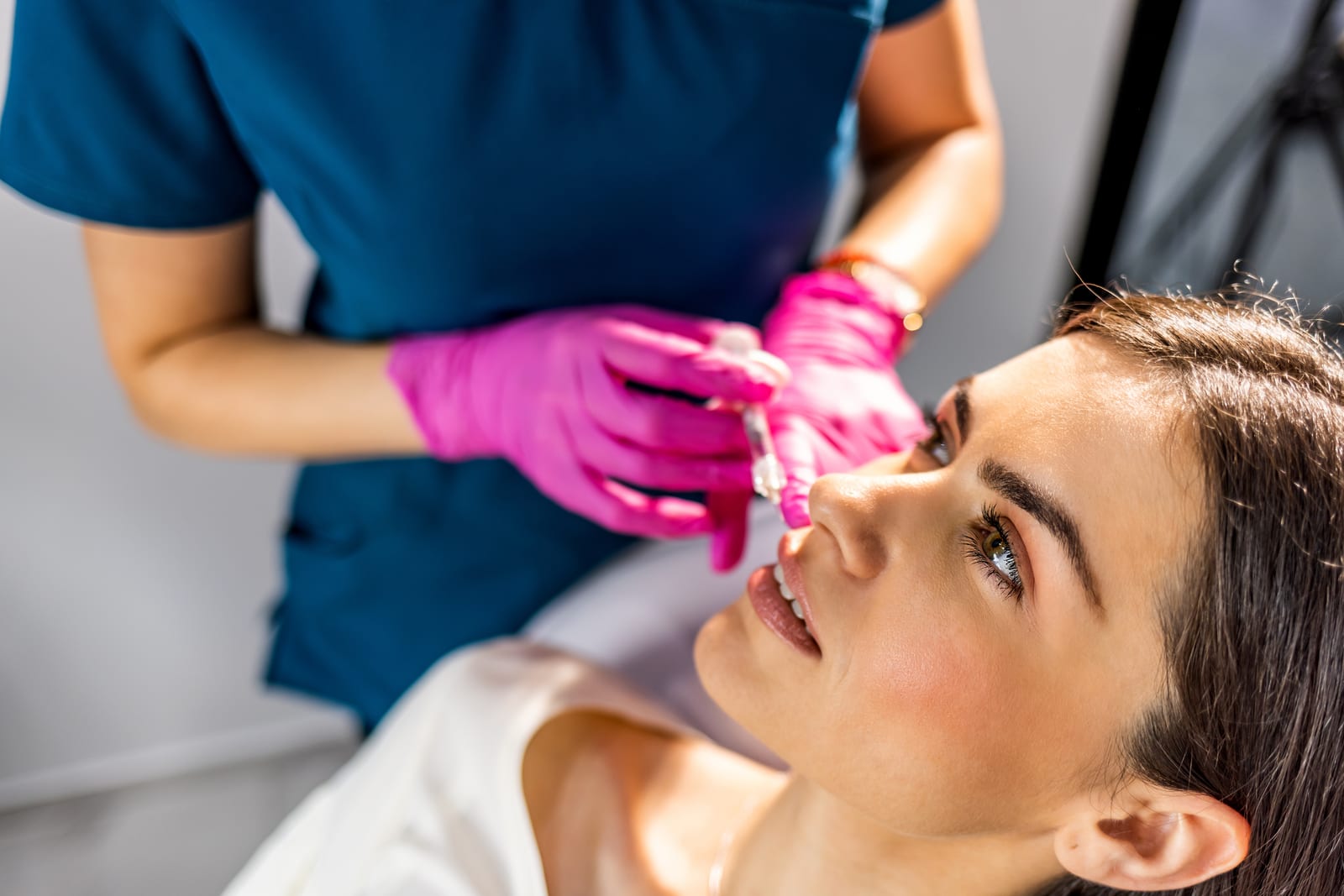
Dermal Fillers in Bellevue, WA
Hyaluronic acid filler placement for lips, midface, jawline, and structural rejuvenation — calibrated to anatomy, never templated.
- Surgeon-Led
Every protocol reviewed through a fellowship-trained facial plastic surgeon's anatomical lens.
- Full Modality Array
Radiofrequency, ultrasound, IPL, picosecond, pulsed-dye, and a complete injectable menu in-house.
- Hospitality-Led
Founded in 2022 around a comfort-first, homey clinic standard — quiet luxury without corporate distance.
- Bellevue Crossroads
15600 NE 8th St, Suite A-8 — minutes from Mercer Island, Kirkland, and Redmond.

Dermal Fillers, Read Against the Anatomy Underneath
A dermal filler is a hydrogel — most commonly hyaluronic acid (the HA family) — that occupies a precise tissue plane to restore lost volume, support a softened contour, or refine a structural feature. The product is the simple part. The judgment is everything else.
Dermal fillers at Sun Aesthetic Clinic are placed against the anatomy underneath them, not against a generic injection grid. Every syringe is planned and reviewed through the lens of a fellowship-trained facial plastic surgeon, so the volume you add reads as restored structure — not added bulk. This is the page for patients who want refined, natural-looking results and who specifically do not want to look filled.
Dermal Fillers, Read Against the Anatomy Underneath
A dermal filler is a hydrogel — most commonly hyaluronic acid (the HA family) — that occupies a precise tissue plane to restore lost volume, support a softened contour, or refine a structural feature. The product is the simple part. The judgment is everything else.
Filler outcomes are decided on three anatomical variables, in this order:
- The plane. Subcutaneous, supraperiosteal, deep medial fat compartment, dermis — each region has a correct plane for the product and the goal. Wrong plane is the most common cause of an outcome that looks puffy or migrates over time.
- The cannula path. Where the cannula enters, where it travels, where it stops. A blunt cannula respects the vascular anatomy around the tear trough, the lip vermillion, and the mid-face arcade in a way a needle alone often does not.
- The bony-soft-tissue support. Filler does not float. It is held by the underlying bone, the periosteum, and the connective scaffolding above it. When that support reads correctly, a smaller volume produces a more refined result than a larger volume placed without anatomical anchoring.
This is where surgical training transfers to non-surgical work. The same anatomical mapping that informs a deep-plane facelift on the surgical side of the practice is the mapping that informs where a filler syringe should go — and where it should not. The surgeon-led standard is not a marketing line; it is the literal review layer on every plan.
Treatment Areas We Map
Every area is approached with the same anti-overfilled stance — we will refuse to over-volumize a region even when requested, because the long-term aesthetic depends on respecting the underlying structure. We will say so directly during consultation, and recommend an alternate protocol where it is the better answer.
- Lips. Vermilion border definition, philtrum support, corrected lip ratio. Softer HA products at conservative volumes, placed slowly. Refined lip work reads as your lip — only rested and proportionate.
- Mid-face and cheeks. The mid-face is the structural anchor of the entire lower face. Volume restored along the zygomatic arch and the deep medial fat compartment lifts the nasolabial region without directly treating it.
- Tear troughs. The most anatomically demanding region in the face for filler. The orbicularis-retaining ligament, the vascular arcade, and the thin overlying skin make plane selection non-negotiable. Not every patient is a tear-trough candidate, and we will say so.
- Jawline contour. Definition along the mandibular border, restoring the angle softened by bone resorption and ligament descent.
- Chin projection. Supraperiosteal placement to lengthen, project, or balance a recessed chin. Frequently the quietest, most powerful filler decision on a profile.
- Marionettes and nasolabial folds. Treated as downstream signs of mid-face descent more often than directly. Volumizing the mid-face is frequently the better answer than chasing the fold itself.
What to Expect in a Filler Session
A typical filler session runs 30 to 60 minutes end to end. The clinical sequence is consistent across regions:
- Numbing. Topical anesthetic is applied to every injection site. Most HA products carry integrated lidocaine for additional comfort during placement.
- Onset. Results are visible immediately. The structural read settles over 2 to 4 weeks as the product integrates with surrounding tissue and mild swelling resolves.
- Longevity. Generally 6 to 18 months, depending on product family, anatomical region, your metabolism, and facial movement over that placement. Lips and perioral work sit on the shorter end; deep structural placements in cheek, jawline, and chin sit on the longer end.
- Downtime. Most patients return to normal activity the same day. Mild swelling and occasional pinpoint bruising are common in the first 3 to 7 days, particularly around lips and tear troughs.
- Follow-up. A complimentary refinement visit is scheduled at 2 to 4 weeks if any small adjustment is appropriate. Refinement is part of the protocol, not an upsell.
Filler Families We Carry
Sun Aesthetic Clinic selects filler per anatomical need, not from a fixed menu of preferred brands.
- HA family (primary). Hyaluronic acid fillers are the backbone of the practice. They are reversible with hyaluronidase if a result is not what was intended, integrate cleanly with native tissue, and cover the full anatomical range from lip to deep cheek. The right starting point for most new filler patients.
- Biostimulator alternatives. When the goal is gradual collagen rebuild rather than immediate volume, we cross-plan with biostimulators — Sculptra in Bellevue for diffuse mid-and-lower-face collagen architecture, and Radiesse in Bellevue for calcium-hydroxylapatite structural contour with biostimulant follow-on. Different tools, different timelines.
The selection logic is anatomical first, brand second.
Provider Authority
Albert Yang, MD, anchors the anatomical-placement standard for every filler plan. He is a fellowship-trained facial plastic surgeon (AAFPRS-recognized fellowship through Emory and Premier Image, prior head-and-neck reconstructive surgery training at UNLV). His surgical work on periorbital, mid-face, and mandibular anatomy directly informs how filler plans are mapped here — particularly in regions where vascular and structural risk is highest.
Dr. Jay Sun, MD — founder and medical director — supports the practice on cosmetic-injectable craft and the unhurried consultation experience that defines the clinic.
Meet your fellowship-trained provider
Frequently Paired With
Dermal fillers rarely work alone. The protocols most commonly sequenced alongside them:
- Botox in Bellevue — softens the dynamic lines filler cannot address. Filler restores static volume; Botox modulates the muscle that creases over it. Complementary tools, not interchangeable.
- Sculptra in Bellevue — biostimulator collagen rebuild on a longer arc. Frequently sequenced alongside HA for both immediate refinement and gradual structural improvement.
- Radiesse in Bellevue — calcium-hydroxylapatite for structural contour with collagen-stimulant follow-on. Useful in jawline and chin work where structural support is the primary goal.
- Ultherapy and Thermage — energy-based lifting protocols that address tissue laxity in a register filler cannot. When the concern is descent rather than volume loss, lifting first, filling second.
The Medical Injectables category hub carries the full sequencing logic across protocols.

The First Step Toward Natural-Looking Results
Every filler plan at Sun Aesthetic Clinic begins the same way — an unhurried conversation, an anatomical read, a refined plan scaled to your goals. No same-day-pressure decisions. No upsell scripts. Surgeon-led judgment on what your anatomy actually needs.
Frequently Asked
How is surgeon-reviewed filler placement different from a standard injection menu?
The difference is the review layer. Every filler plan is mapped against the anatomical planes underneath your skin — not against a memorized injection grid. Albert Yang, MD, reviews placement logic on the regions where surgical training transfers most directly: tear troughs, mid-face, jawline, and chin. The result is a smaller total volume, placed more precisely, in a plane correct for your anatomy.
Will I look overfilled?
No — and we will refuse to take a plan to that outcome even if requested. Our protocol is the smallest volume that achieves the goal, then refine at follow-up if appropriate. Reviewing photos of your own face from 5 and 10 years ago is one of the most useful inputs. The goal is restoration of your features, not redesign of them.
Is the filler reversible?
HA-family fillers can be dissolved with hyaluronidase if a result is not what was intended or if a complication develops. This reversibility is part of why HA is the most common starting point. Biostimulator alternatives like Sculptra and Radiesse are not reversible in the same way, which is one reason the planning conversation matters as much as product selection.
What is the bruising and swelling timeline?
Mild swelling is common in the first 3 to 7 days, particularly in lip and tear-trough placements. Pinpoint bruising can occur at injection sites and typically resolves within 7 to 10 days. The settled appearance is read at 2 to 4 weeks, which is when any refinement visit is scheduled.
Is pricing published on the site?
Pricing is shared in consultation rather than on the page — most filler conversations frame cost as a per-syringe investment, with a clear written total before any treatment occurs. No same-day pressure to proceed. Financing options are available through our financing page.
Filler vs. Sculptra vs. Botox — how do you decide?
The decision is driven by what the anatomy is doing. Static volume loss reads as a filler conversation. Diffuse collagen thinning reads as a Sculptra or biostimulator conversation. Dynamic expression lines read as a Botox conversation. Most patients land on a sequenced plan that uses two of the three.
Related treatments in your category.
Botox & Wrinkle Relaxers
Wrinkle-relaxer treatments — Botox, Dysport, and refined neuromodulator alternatives — placed with anatomical precision by a fellowship-trained surgeon's lens.
Learn more Medical InjectablesSculptra
Poly-L-lactic acid biostimulator that gradually restores collagen architecture over a series of treatments.
Learn more Medical InjectablesRadiesse
Calcium hydroxylapatite biostimulator for jawline contour, hand rejuvenation, and structural lift.
Learn more Medical InjectablesPRP / DermaPRP
PRP (platelet-rich plasma) is our autologous regenerative therapy for skin, hair, and scar revision. When structural volume is needed, it is transformed into DermaPRP — a biofiller injected like a dermal filler.
Learn more Medical InjectablesNano Fat Stem Cell Therapy
Surgeon-administered autologous nano fat protocol for facial regeneration and skin quality.
Learn morePricing is shared in consultation.
Our pricing is a function of the protocol your anatomy actually needs — not a menu line item. We share specifics during your complimentary consultation, where every cost is contextualized inside the plan it belongs to. Financing options are available for protocols of greater scope.
